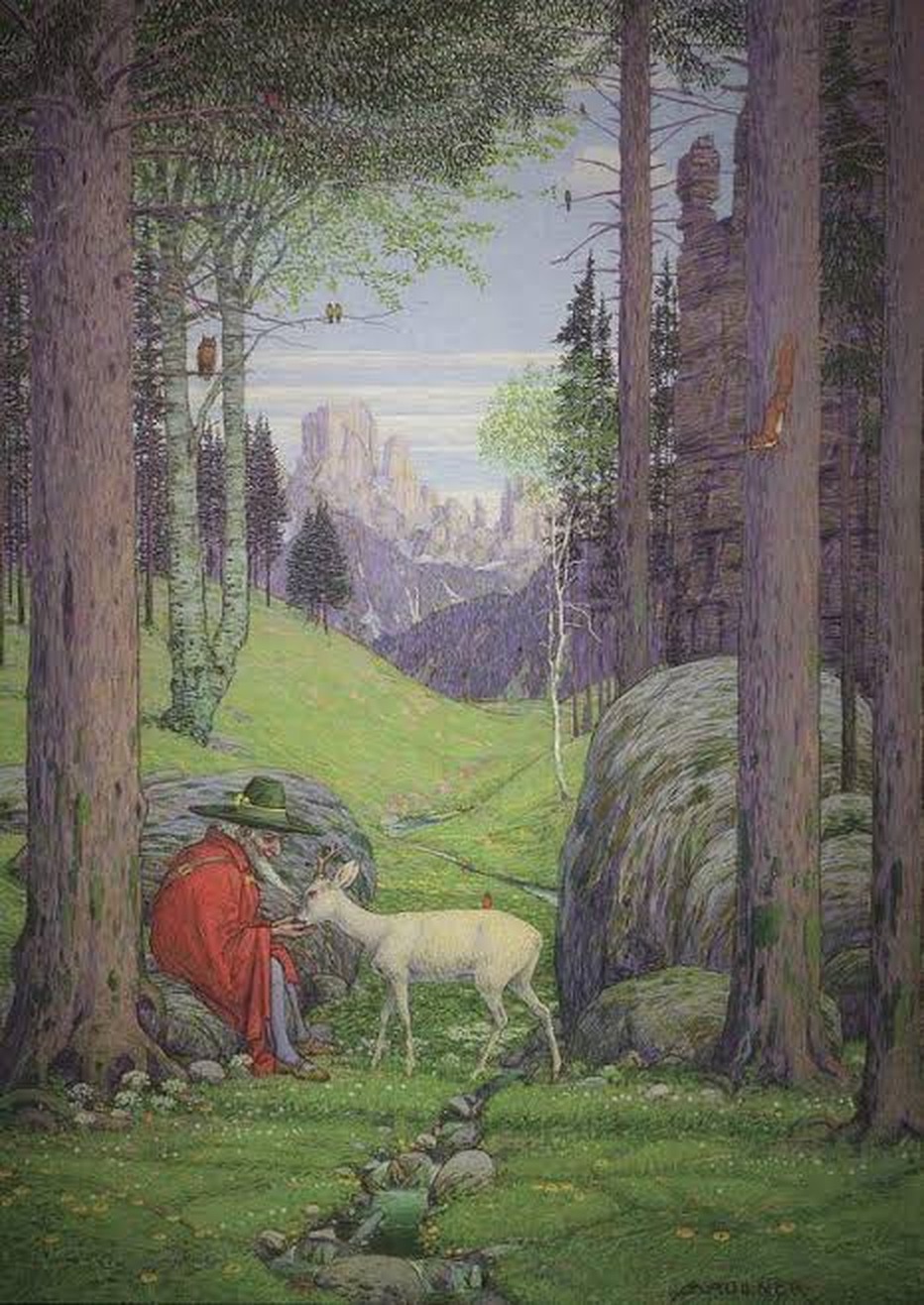
The same mind that's good at this is the mind most at risk from it
This material doesn't attract people at random. It has a real, measurable pull on a specific kind of mind — and understanding why is the fastest way to understand both what makes esoteric study genuinely valuable and where it can go wrong.
Who this tends to pull in
Personality research consistently finds that interest in esoteric, occult, and paranormal material correlates with Openness to Experience — the Big Five trait covering intellectual curiosity, comfort with ambiguity, and a pull toward unconventional ideas. It's one of the more reliably replicated findings in this area of psychology, showing up across independent samples using different measures. The same research generally finds this has little to do with intelligence or education; it's a difference in temperament, not capability.
Underneath that trait sits something more mechanical. Neuroscience research on paranormal belief has repeatedly linked it to a cognitive style built around loose, associative pattern-detection — a lower threshold for deciding that two things are meaningfully connected. Studies manipulating dopamine levels find they shift this threshold directly: raise dopaminergic activity and people get measurably better at spotting faces in noise, connections between unrelated words, similarities between random shapes — the same signal-detection setting that, turned up further, produces both paranormal belief and, at the far end, positive psychotic symptoms.
The same wiring is a genuine asset
This isn't a deficit dressed up as a personality trait. The identical associative machinery is implicated directly in creativity research: the same loose, far-reaching pattern-detection that lets someone find a hidden thread through an alchemical text is what lets a scientist notice an unexpected connection between two fields, or a poet land a metaphor that shouldn't work but does. Researchers in this area have described paranormal ideation and creative ideation as drawing on the same underlying cognitive resource — not a coincidence of personality, but two expressions of one trait.
Put plainly: if you're the kind of person who finds esoteric systems magnetic — who can hold a dozen symbolic threads at once and sense where they connect — that's not a warning sign by itself. It's very likely the same trait that makes you good at pattern-heavy work generally. The site isn't arguing this interest is a problem. It's arguing that the exact same setting that makes the pattern-detection generative in a studio, a lab, or a peer group can misfire badly with no one else checking its output.
There's a name for the underlying dial
Psychologists have a term for the broader trait these findings keep circling: transliminality — how easily material crosses the threshold between unconscious and conscious awareness. It's measured as a single dimension underlying several things that look unrelated on the surface: absorption in fantasy or art, heightened sensitivity to stimuli, vivid dream life, and a pull toward mystical or magical thinking. High scorers tend to be unusually creative. The same research measuring this trait has also found it correlates with schizotypy — the same broad vulnerability referenced throughout this site. It's a genuinely double-edged dial, not a euphemism for pathology, and where any one person lands on it says nothing on its own about where they'll end up.
Same underlying dial, two settings. A tighter filter lets a little through at a time; a looser one — creative on a good day — can flood under enough input.
No mystery school ever worked alone
Every tradition built around hidden or esoteric knowledge — Hermetic orders, Kabbalistic study circles, alchemical guilds, shamanic lineages, monastic contemplative schools — required initiates to study under a teacher or inside a community. That wasn't gatekeeping for its own sake. It was a safety structure, built the hard way, over centuries of watching what happens when a mind naturally built to find connections has nobody to check which ones are real.
Strip that structure away and the research doesn't stop being interesting, or stop being a legitimate use of a genuinely valuable trait. It stops having anyone in the room who can say "you're stretching that connection too far." This site is about what fills that gap when nobody does, and how to keep a research practice grounded when it's just you and the books.
What that supervision actually looked like
This wasn't a vague gesture toward "tradition." Specific systems built specific, sometimes rigid checkpoints in:
The oldest documented version of this restriction is Jewish, and it's genuinely old: the Mishnah (compiled c. 200 CE) rules in tractate Chagigah 2:1 that the esoteric "Account of the Chariot" (Ma'aseh Merkavah) may not be taught to more than one student at a time, and only to a student the teacher already judges wise enough to grasp most of it unaided — the teacher hands over chapter headings, not the whole doctrine, and the student has to complete the rest through their own understanding. The Talmud attaches a specific cautionary story to this rule: four sages are said to have entered the mystical "orchard" (pardes) together. One died, one lost his sanity, one became an apostate, and only Rabbi Akiva "entered in peace and left in peace." Whatever one makes of the story historically, it was told for a reason — as a direct warning about what happens without exactly the kind of controlled, one-on-one supervision the Mishnah had just prescribed. The Hermetic Order of the Golden Dawn, founded in London in 1888, built a similarly explicit graded curriculum centuries later: an aspirant had to pass a written examination on each of four elemental grades, then further examinations and the consent of existing adepts, before being permitted to advance — up to eight formal checkpoints between entry and full initiation. Rinzai Zen structures koan study around sanzen, a private, recurring interview where a student presents their understanding directly to a teacher who tests it — a relationship that typically runs for years, sometimes decades, precisely because no one is trusted to self-certify their own insight.
Worth being honest about the limits of this pattern, too: it isn't universal even within traditions that clearly valued it. Isaac Luria — the source of an entire later school of Kabbalah — reportedly spent years in solitary seclusion by the Nile studying the Zohar alone before he ever taught anyone, and died at 38, before what later folklore claims was the minimum age to study his own system. The insight came from solitude; the checkpoint arrived afterward, built by the community that received it. That's a real complication, not a footnote to explain away — it suggests the protective function here isn't "never work alone," but "don't be the only person who ever gets to evaluate what solitude produced."
Different traditions, wildly different content — but every one of them built in a checkpoint nobody could skip. That's the piece solitary research online tends to have zero of.
Your brain is built to find patterns. Esoteric texts are built to reward that.
The tendency to see meaningful connections in random or ambiguous data has a name: apophenia. It's not a flaw — it's the same pattern-seeking machinery that lets you recognize a face in a crowd or catch a rhyme in a poem. It becomes a liability specifically in domains built from ambiguous, symbolic material with no ground truth to check against — which is exactly what esoteric and occult texts are.
In a group setting, a peer or teacher provides friction: someone points out when a connection is coincidence rather than revelation. Working alone removes that check entirely. Nothing pushes back. Every thread you follow only ever confirms itself, because you're the only one deciding which threads count.
Same twenty-one points, every time. The line connecting six of them isn't in the data — it's a decision made by whoever's looking.
Where the clinical language comes from
Psychiatrist Klaus Conrad mapped this territory in 1958, studying the earliest phase of psychotic breaks in a large sample of patients. He described a prodromal state he called Trema — a mounting sense that the ordinary world has become unusually charged with meaning, that something important is about to reveal itself — which can precede a phase he called Apophänie: the moment scattered perceptions crystallize into a single, all-explaining revelation.
Conrad wasn't describing occultists — he was describing early schizophrenia in a psychiatric ward. But the shape of the process he documented is the same shape that intensive, unmentored esoteric research can induce on its own: hours spent training attention to find hidden significance in ordinary symbols is, mechanically, practice at generating exactly the state he described.
The biological version of the same story
Conrad was describing what this feels like from the inside. Psychiatrist Shitij Kapur's aberrant salience model, one of the most cited frameworks in modern psychosis research, describes the same territory from underneath: dopamine's core job isn't pleasure, it's flagging what's important — deciding which things in the environment deserve attention and meaning. When that system misfires, ordinary stimuli start getting tagged as urgently significant, and the felt sense of revelation Conrad documented is what that misfire feels like from inside the person having it. It's worth being fair to the current state of the science: a 20-year retrospective on Kapur's model found some of its specific predictions haven't held up well against newer data, even though the general framework remains the field's standard shorthand for how delusions form.
The search itself is rigged
Apophenia explains why a stray connection gets noticed. Confirmation bias explains what happens next: once a theory exists, people search for, interpret, and recall information in ways that favor it, largely without noticing they're doing it. Psychologist Raymond Nickerson's landmark review of this literature calls it "the most problematic" of all cognitive biases precisely because it's invisible from the inside — it doesn't feel like bias, it feels like the evidence keeps agreeing with you. A peer group interrupts this mechanically: someone else runs their own search over the same material and doesn't reliably land on your conclusion, which is the fastest way to notice the search was rigged in the first place. Alone, every new source you find has already been filtered by the theory it's supposed to be testing.
Stress turns the dial up
None of this happens at a fixed intensity. A well-known set of experiments found that people who were made to feel they'd lost control over their circumstances — through a rigged task, a recalled memory of powerlessness, workplace instability — became reliably more likely to see patterns in pure visual noise, find correlations in random stock data, endorse conspiracy theories, and develop superstitions, compared to people who felt in control. The effect reversed when people were given a chance to affirm their values and self-worth first. Isolation, financial pressure, health scares, a bad year — anything that erodes someone's sense of control over their life — measurably turns up the same dial this entire site has been describing, independent of anything the person is reading.
A rough sketch of the Whitson & Galinsky effect: less felt control over your circumstances tracks with more patterns found in the same random data.
Overvalued idea, or delusion?
Not every strong esoteric belief is a red flag. Psychiatry draws a specific, useful line here — one that has nothing to do with how strange the belief sounds, and everything to do with whether doubt is still alive.
The dividing line isn't content — it's whether contrary evidence can still land.
Psychiatrist Karl Jaspers set out the distinction in 1913 and it still anchors the diagnostic literature today.
Overvalued idea
A belief that dominates a person's time and attention, is emotionally important to them, and that they actively defend — but that still admits doubt. Shown solid counter-evidence, the person can say some version of "I know how that sounds, and I could be wrong, but I still think there's something here." The idea is usually egosyntonic: it fits the person's sense of who they are, and they enjoy holding it.
Delusion
A fixed belief that has stopped being falsifiable. Counter-evidence doesn't reduce confidence — it gets absorbed into the theory. Show a researcher convinced they've found a hidden pattern in a city's street grid the zoning records that explain it as ordinary infrastructure planning, and a delusion doesn't update — it recruits the records themselves as further proof of the cover-up.
The DSM-5 also carves out an explicit exception worth knowing: a belief shared and normalized by a genuine cultural or religious community is not classified as a delusion, however unusual it looks from outside. That's the actual mechanism behind why community matters here — it isn't about tempering how "out there" an idea is, it's that a group gives a belief somewhere to be checked, and somewhere to be normal, instead of privately escalating.
This isn't hypothetical — it's a documented clinical category
Psychiatry has a specific diagnostic category for crises that emerge from intensive spiritual, contemplative, or esoteric practice: the DSM includes "Religious or Spiritual Problem" (V62.89), added in recognition that deep, destabilizing practice-related crises were showing up in emergency rooms and being misdiagnosed as primary psychotic illness when they were something narrower and often more treatable.
The most detailed modern data on this comes from Brown University's decade-long Varieties of Contemplative Experience project, led by Dr. Willoughby Britton and Dr. Jared Lindahl. Interviewing more than 100 meditators and teachers, the study catalogued dozens of categories of genuine, sometimes long-lasting adverse effects from intensive contemplative practice — and a related 2025 paper from the same lab specifically documents delusion-like ideation in Western practitioners, including the belief that one has been given a special mission to "save the world."
Meditation and esoteric research aren't identical practices, but they share the exact structural risk this site is about: both are dismantling practices, deliberately built to loosen a person's ordinary hold on consensus reality, and both were traditionally undertaken inside a teacher-student relationship for exactly that reason. The Brown researchers found, again and again, that the presence or absence of a knowledgeable guide was one of the clearest factors separating a difficult-but-integrated experience from a genuinely harmful one.
None of this means solitary research causes psychosis in a healthy person. It means solitary, intensive, reality-dismantling research removes a specific safety mechanism, and clinical literature is consistent about what tends to fill that gap when it's missing for long enough.
How this actually happens, mechanically
Beyond apophenia and the overvalued-idea spectrum, five more specific, verifiable mechanisms explain how solitary esoteric research can tip from an intense hobby into something that erodes a person's grip on reality.
Reality monitoring failure
Psychologist Marcia Johnson's source monitoring framework describes how the brain tags a mental experience as either internally generated (imagination, thought) or externally derived (something actually seen or heard). Hours spent visualizing esoteric symbols or holding metaphysical concepts in mind strengthens exactly the internal-imagery pathways this tagging system has to sort. When that tagging fails, an internally generated thought — a visualized pattern, a felt presence — gets misfiled as an external perception. This is a well-studied cognitive mechanism, not a metaphor.
Both lanes pass through the same tagging step. Under heavy load, an internally generated symbol can come out the other side mislabeled as something that was actually seen.
Jung's "psychic inflation"
Carl Jung studied esoteric and alchemical material more deeply than almost any other clinician of his era, and he was explicit about the risk of doing so ungrounded. He described psychic inflation: when a person's ego over-identifies with a powerful symbolic idea instead of simply observing it, and starts to merge with it — no longer studying the archetype of the sage or the prophet, but quietly coming to believe they are one. Jung's own prescribed countermeasure was almost anticlimactic: a deliberately ordinary physical life. He pushed patients toward gardening, manual work, and routine specifically to keep the ego load-bearing enough to hold serious symbolic material without being taken over by it.
Circadian collapse as the physical trigger
None of the above happens in a vacuum — it happens on top of a body. Deep sleep is when the brain clears metabolic waste that accumulates during heavy cognitive load, and prolonged wakefulness or a wrecked sleep schedule is one of the most reliable ways to induce transient psychotic symptoms in an otherwise healthy person. A 2014 controlled study found sleep deprivation alone could produce measurable psychosis-like symptoms in healthy volunteers, and clinical case reports of sleep-deprivation psychosis in shift workers describe the same hallucinations and paranoia seen in acute psychiatric crises — fully reversible once sleep is restored. A late-night research habit that eats into sleep isn't a neutral detail; it's plausibly doing a meaningful share of the damage.
Not measurements of any real individual — a sketch of the general shape the cited research describes: sleep debt and rising cognitive load move in opposite directions, and the gap between them is where risk compounds.
The algorithm as a false peer group
Recall the earlier point: a delusion is far less likely when a belief is shared and checked by a real community, and far more likely when it's held in total isolation. Recommendation algorithms complicate that picture in a way clinical literature is only starting to catch up with. A search engine or video platform optimized for engagement will keep surfacing content that confirms whatever theory a person is already chasing, because confirmation is what keeps them watching. That can start to feel like social validation — like a whole community agrees — without any of the actual pushback, boredom, or disagreement a real peer group would provide. It's worth naming plainly: this isn't the same as a clinically defined syndrome, but the shape of the risk is real and worth watching for in your own research habits.
Five people, real disagreement. The crossed mark is where a claim got pushed back on.
One person, one loop. Confirmation goes out, more confirmation comes back — nothing external ever enters it.
Repetition alone tightens what apophenia loosens
There's a well-established mechanism from depression research that maps onto solitary theorizing more closely than its origin suggests. Rumination — repetitively returning to the same thought, alone, without new input — has been shown across dozens of studies to entrench whatever state it's applied to: it strengthens negative thinking, measurably impairs problem-solving, and erodes the social support that might otherwise interrupt it. It was studied in the context of depressed mood, not esoteric belief, so this is a parallel, not an identical claim — but the mechanism it describes is content-neutral. Going over the same theory alone, night after night, isn't the same as reasoning your way to a stronger conclusion. It's closer to grooving a track that gets harder to leave the more times a thought runs down it, whether the thought is despair or a revelation about a hidden pattern.
Nothing new enters between passes. Each return narrows the track a little more than the last one.
What starts to change in how the world feels, and how you talk
The last layer isn't about beliefs at all. It's about perception, the boundary of the self, and eventually language itself — three more places solitary esoteric practice can leave a mark, each with real clinical grounding and each easy to overstate.
Derealization: when the world stops feeling real
Most esoteric systems — Gnostic, Hermetic, Advaita Vedanta — share a premise: the physical world as perceived is an illusion, a veil, or a trap. Sitting with that premise intensively is different from studying it as an idea. Depersonalization/derealization disorder (DPDR) is a recognized DSM-5 dissociative diagnosis: persistent feelings of detachment from one's body or mental processes, or a sense that one's surroundings are unreal, foggy, or dreamlike, while still knowing rationally that they aren't. It's not rare in mild, brief form — a large share of people have a passing episode at some point — and research specifically links intensive meditation to triggering it. Traditionally, practices designed to induce exactly this feeling were run for short, supervised windows before a teacher deliberately brought the student back. Alone, there's no one to end the session.
A quieter sense of self
fMRI studies of experienced meditators show something concrete happening in the brain during contemplative practice: relative deactivation of the default mode network (DMN), the set of regions most associated with self-referential thought and the ongoing sense of "me." That deactivation is part of what produces feelings of unity or ego dissolution during deep practice — it's real neuroscience, not just a metaphor for a mood. The open question is what holds a person together while that boundary is temporarily down. Traditional settings answered this with heavy social structure around the practitioner during and after the experience. Studying alone removes that structure at precisely the moment the sense of self is least defended.
Philosophically-minded psychiatry has a name for what it feels like from the inside when that boundary weakens: ipseity disturbance (from ipse, Latin for "self"). Psychiatrists Louis Sass and Josef Parnas argue this self-disturbance — not any single symptom — is the deepest common thread running through schizophrenia. It has two faces that sound contradictory but tend to arrive together: hyperreflexivity, where automatic background processes (the felt sense of your own thoughts, your own body) get thrust into the foreground and examined like external objects, and a fading sense of just being simply, unreflectively present as yourself. This isn't a fringe theory — it's still actively debated and refined in the clinical literature two decades on. It maps closely onto what a weakened DMN would predict from the neuroscience side, and it's the more precise language for the "watching myself from outside" feeling this kind of intensive, self-examining practice can produce.
Paradox as a trap for a logical mind
Anthropologist Gregory Bateson proposed in 1956 that being repeatedly caught in an unresolvable logical contradiction — a "double bind" — could, over time, produce schizophrenic symptoms. It's worth being straightforward about where this idea actually stands: later research broadly failed to support double-bind exposure as a cause of schizophrenia, and the theory is now considered scientifically disconfirmed as an explanation of the illness, even though the term stuck around in family-therapy language. What survives it is a narrower, more defensible observation: koans, alchemical maxims, and other intentionally paradoxical esoteric texts are built to resist binary logic, and a highly systematic mind that treats them as a puzzle with a hidden correct answer can spend enormous cognitive effort trying to "solve" something built to be unsolvable. That's a real source of frustration and fatigue — just not, on current evidence, a documented pathway to psychosis on its own.
Both readings route back to the same unanswered question. The text was built that way on purpose — the cost is the hours spent circling it, not a documented break with reality.
When jargon stops being translatable
Esoteric material runs on dense, specialized language, and heavy solitary use of it can produce a real, observable drift: words pick up narrow, personal meanings that make perfect sense internally but don't survive contact with someone outside the framework. That's a genuine social risk worth naming on its own — it's a fast way to lose the very peer or mentor this whole site argues for, since a person can't get useful pushback on an idea nobody else can parse. It's a different thing from disorganized speech (sometimes called "word salad" clinically), which is an actual formal thought disorder and a diagnostic symptom of psychosis, not a natural extension of having an idiosyncratic vocabulary. Worth being precise about the difference: one is a communication habit that isolation makes worse and community would fix; the other is a specific clinical symptom. Don't let the first read as evidence of the second.
How the trap gets sealed shut
Four last pieces, closing out the picture: how a belief system becomes immune to correction, what happens to the body while all this is going on, a real sleep-boundary phenomenon that's easy to over-read, and a subtler trap in how solitary researchers try to reconnect.
When a belief system stops taking outside input
Philosophers of science who study conspiracy theories and pseudoscience use the term self-sealing belief systems (sometimes "epistemic closure") for a specific structural failure: a framework built so that any evidence against it gets reinterpreted, using the framework's own logic, as further proof of the framework. It's not that the person stops thinking — it's that every tool they're using to check their thinking was issued by the thing being checked. This is exactly what a real peer group interrupts: an outside person isn't running on the same closed logic, so they can name a flaw the internal system is structurally unable to name about itself.
Contrary evidence reaches the belief and it moves.
Evidence hits the wall and bounces off relabeled. Belief only ever hears itself.
The body keeps a tab
Esoteric traditions are overwhelmingly cerebral — mind, spirit, and symbol are the focus, and the body is often treated as secondary or illusory. Sustained psychological stress, independent of its source, is well documented to show up physically: unexplained fatigue, tension, pain, and other somatic symptoms are a recognized clinical pattern, not a sign of weak character. None of this is unique to esoteric research — it's a general stress-response finding — but it's a reason the physical grounding habits mentioned earlier in this piece (routine, manual tasks, anything with hard physical tolerances) aren't just a nice add-on. They're one of the few direct ways to interrupt a stress response that pure thinking can't think its way out of.
The Tetris effect, and what it isn't evidence of
People who spend long, intense stretches on a visual task reliably report intrusive, involuntary imagery from that task at sleep onset — a well-replicated finding first documented with Tetris players, whose game pieces kept reappearing behind their eyes as they fell asleep, even in some patients with no ability to consciously recall playing. It's a real feature of ordinary memory consolidation, not something specific to esoteric material. The risk here is entirely interpretive: someone who has spent a day steeped in occult symbols and already believes dreams and the edge of sleep are contact points with other realms is primed to read this same, ordinary phenomenon as an external visitation rather than what it demonstrably is — the brain replaying what it worked on all day.
Feeling connected while staying alone
Researchers who arrive at ideas they believe could help people often want to share them — publishing, posting, writing something meant to "wake people up." Done entirely through asynchronous digital channels, this can deliver a real sense of purpose and connection without any of the friction of an actual relationship. Social psychology has documented adjacent versions of this under names like slacktivism and moral self-licensing: an action that feels meaningfully prosocial but substitutes for, rather than leads to, real engagement. Applied here, it's a quiet way the loop stays closed — a person can feel deeply connected to "humanity" in the abstract while the specific, disagreeing, real humans who'd actually check their thinking never enter the picture.
Signs it's time to bring someone else in
This is a prompt for reflection, not a diagnostic tool, and it isn't a checklist for evaluating anyone but yourself. If several of these feel true and persistent, the right next step is a conversation with a person you trust or a licensed professional — not more solo research.
- 01
Every new thing you read confirms the same theory
If nothing you've encountered in months has genuinely complicated or contradicted your framework, that's not confirmation — it's a sign nothing is being allowed to.
- 02
Ordinary events feel aimed at you
Coincidences, overheard phrases, or unrelated news starting to feel like they carry a private message meant specifically for you.
- 03
You've stopped being able to say "I could be wrong"
The line between overvalued idea and delusion. If disagreement now reads as evidence of a cover-up rather than a fair challenge, that's the marker worth taking seriously.
- 04
Sleep, meals, and other people have quietly dropped away
The research has started displacing the basic maintenance of a life, not just filling spare time.
- 05
You feel uniquely positioned to see what others can't
A growing sense of being specially chosen, awakened, or burdened with knowledge that sets you apart from — or above — everyone around you.
- 06
Metaphor has started to feel literal
Symbolic or allegorical material beginning to read as direct, physical instruction or literal external fact rather than a framework for internal reflection.
What mystery schools actually provided
The historical fix was never secrecy or gatekeeping for its own sake. It was three concrete things: a witness, a tether to ordinary life, and — easy to miss from outside — a body doing something. All three are reconstructable without joining an order.
Mentor and community carry the weight while the center is deliberately loosened.
Nothing else was carrying the load. Algorithms don't provide structural support.
The body was never actually optional
Everything on this site so far has treated esoteric practice as something that mostly happens on a page or a screen — reading, pattern-finding, holding concepts in mind. That's a fair description of how most solitary digital research actually happens, but it's a narrow slice of what mystical practice has historically been. Chant, fasting, controlled breath, physical vigil, prostration, pilgrimage, dance: across traditions, the material was engaged with the whole body, not just worked through conceptually. A framework that treats the mind as the only instrument — and the body as scenery, or an afterthought to manage once it starts breaking down under stress — has already dropped something the traditions themselves didn't.
An earlier version of this section claimed solitude itself is what tends to strip the embodied part out, on the theory that groups produce ritual as a byproduct of doing anything together and solitary practice doesn't. That claim doesn't survive contact with the actual history and deserves a direct correction rather than a quiet edit. Abraham Abulafia, the 13th-century founder of ecstatic Kabbalah, built an entire technical discipline of breath, chant, and letter-combination — and his own instructions specifically prescribe solitude as the precondition for it: find a room, shut out every other voice, and practice alone. Scholars of his work note he pushed the value of withdrawal from community further than any Kabbalist before him. Solitary shamanic practice, similarly, is common cross-culturally once initiation has occurred — the foundational (if now dated and contested) survey of the field describes ecstatic techniques, often involving real physical exhaustion, that a practitioner carries out alone. Solitude plainly does not prevent embodied ritual. Individuals have built extraordinarily demanding physical disciplines entirely by themselves, sometimes more rigorous than anything a group requires.
The actual gap is narrower and more specific: modern solitary digital research — reading forums, PDFs, watching videos — doesn't organically produce embodied practice the way historical solitary disciplines did, not because solitude forbids it, but because nothing about scrolling a screen asks anything of the body, and nobody built the discipline in on purpose. Abulafia and the shamanic initiate didn't stumble into ritual; they constructed it deliberately, often as rigorously as any group tradition would have. That's the missing piece for most people doing this kind of research today — not solitude itself, but the deliberate construction of a practice, which takes exactly the kind of discipline a search bar doesn't ask for.
None of this changes the actual research on what ritual does once it exists: a major review of the experimental literature found that structured, repeated ritual action reliably reduces anxiety and regulates emotion, independent of whatever beliefs the ritual is attached to, and a separate controlled study found rituals performed immediately before a stressful task measurably lowered anxiety and improved performance regardless of whether participants "believed" in the ritual's stated purpose. That mechanism is available to anyone who builds it in, alone or otherwise.
One person — a friend, a peer researcher, a therapist — who hears your theories out loud regularly and has explicit permission to say "that's a stretch." The value isn't their expertise in the subject. It's that they're external.
A reading group, forum, or peer circle studying the same material. Shared, normalized belief inside a real group is treated differently — clinically and practically — than the same belief held in total isolation.
Fixed daily anchors to the physical, mundane world — work, meals, chores, other people's schedules — that don't bend around the research. Historically: chop wood, carry water.
Before accepting a major new connection, write down what evidence would change your mind — and check back later whether you'd actually still let it.
A fixed, repeated, embodied element — a specific posture, a chant, a breath count, a walk taken the same way each time. This has to be built on purpose; nothing about reading alone produces it automatically. Historical solitary mystics didn't skip this — they were often more disciplined about it than any group tradition.
Making this concrete
"Find a witness" is easy to agree with and easy to never actually do. In practice it comes down to three unglamorous steps, in this order:
Not a support group, not a subject-matter expert — just one specific person, on a schedule, who's been asked directly to push back.
A few concrete options, roughly in order of how much structure they provide: a standing weekly call with a friend where you talk through what you've been reading, no exceptions; a small reading group — even two or three other people — working through the same source material on a shared schedule; a therapist or counselor, who doesn't need subject-matter expertise to do the one thing that actually matters here, which is asking good questions about your certainty; or, for material with a real institutional lineage, a genuinely vetted teacher or program rather than the first charismatic voice an algorithm surfaces. The common thread in all four is the same: a real person, met with regularly, who has been explicitly told their job is to disagree when something doesn't hold up — not to validate, and not to co-sign.
Common questions
Can studying esoteric or occult topics alone actually trigger psychosis?
Reading about the occult doesn't by itself cause psychiatric illness in a healthy brain. But intensive, isolated practice that deliberately dismantles a person's ordinary framework of reality can act as a genuine psychological stressor, and the clinical literature on contemplative practice documents real adverse effects — including delusion-like ideation — in vulnerable people who pursue this kind of work alone, without a teacher or peer group to provide correction.
What is the difference between an overvalued idea and a delusion?
Whether doubt survives. An overvalued idea is a strongly held, preoccupying belief the person can still acknowledge might be wrong. A delusion is incorrigible — it doesn't yield to contrary evidence; the evidence gets absorbed into the belief instead.
What is apophenia, and why is it specifically dangerous here?
Apophenia is the tendency to find meaningful connections in random or ambiguous data. Esoteric material is symbolic and open-ended by design, so it's unusually fertile ground for this. Without a peer or mentor to push back on a stretched connection, there's no external check on which patterns are real.
Why did historical mystery schools always require a mentor?
Because the core work of these traditions — dismantling a student's ordinary worldview to make room for a new one — is inherently destabilizing. The mentor's job was less about handing down secret answers and more about catching literal misreadings of symbolic material before they hardened into fixed belief.
Does this mean I shouldn't research esoteric topics at all?
No. It means doing it the way every tradition that survived contact with this material did it: with at least one other person in the loop, regular contact with ordinary life, and a real willingness to be told you're wrong.
If this is describing something happening to you right now — not a past pattern, but a current, escalating sense that reality is reorganizing around a hidden meaning, or that you or someone you know may be in crisis — please reach out to a trusted person or a professional directly. In the US, you can call or text 988 (Suicide & Crisis Lifeline) for free, confidential support, any time.
References
- Smith, M.D., Johnson, J.J., Hathaway, W. (2009). "Personality Contributions to Belief in Paranormal Phenomena." Individual Differences Research. MacDonald, D.A. (2000). "Spirituality: Description, Measurement, and Relation to the Five Factor Model of Personality." Journal of Personality.
- Krummenacher, P., Mohr, C., Haker, H., Brugger, P. (2010). "Dopamine, Paranormal Belief, and the Detection of Meaningful Stimuli." Journal of Cognitive Neuroscience, 22(8), 1670–1681.
- Brugger, P. (2001). "From Haunted Brain to Haunted Science: A Cognitive Neuroscience View of Paranormal and Pseudoscientific Thought." In Houran, J. & Lange, R. (Eds.), Hauntings and Poltergeists: Multidisciplinary Perspectives.
- Denisoff, D. "The Hermetic Order of the Golden Dawn, 1888–1901." BRANCH: Britain, Representation and Nineteenth-Century History. Wikipedia, "Rinzai school" — on sanzen and koan training structure.
- Mishnah, Chagigah 2:1 (c. 200 CE). Babylonian Talmud, Chagigah 13a–14b (the Pardes narrative). Luria biographical details per Encyclopaedia Britannica and Encyclopedia.com, "Isaac ben Solomon Luria."
- Hobson, N.M., Schroeder, J., Risen, J.L., Xygalatas, D., Inzlicht, M. (2018). "The Psychology of Rituals: An Integrative Review and Process-Based Framework." Personality and Social Psychology Review, 22(3), 260–284.
- Brooks, A.W., Schroeder, J., Risen, J.L., Gino, F., Galinsky, A., Norton, M.I., Schweitzer, M.E. (2016). "Don't Stop Believing: Rituals Improve Performance by Decreasing Anxiety." Organizational Behavior and Human Decision Processes, 137, 71–85.
- Idel, M. The Mystical Experience in Abraham Abulafia. State University of New York Press. On Abulafia's prescribed solitude: Ḥayey Ha'Olam Haba, cited via My Jewish Learning, "Abraham Abulafia & Ecstatic Kabbalah."
- Eliade, M. Shamanism: Archaic Techniques of Ecstasy. Originally published as Le Chamanisme et les techniques archaïques de l'extase (Payot, 1951); trans. Trask, W.R. (Princeton University Press, 1964). A foundational but now dated and contested survey.
- Nickerson, R.S. (1998). "Confirmation Bias: A Ubiquitous Phenomenon in Many Guises." Review of General Psychology, 2(2), 175–220.
- Whitson, J.A., Galinsky, A.D. (2008). "Lacking Control Increases Illusory Pattern Perception." Science, 322(5898), 115–117.
- Nolen-Hoeksema, S., Wisco, B.E., Lyubomirsky, S. (2008). "Rethinking Rumination." Perspectives on Psychological Science, 3(5), 400–424.
- Conrad, K. (1958). Die beginnende Schizophrenie: Versuch einer Gestaltanalyse des Wahns. Thieme. English overview: Mishara, A.L. (2010). "Klaus Conrad (1905–1961): Delusional Mood, Psychosis, and Beginning Schizophrenia." PMC2800156.
- Jaspers, K. (1913). Allgemeine Psychopathologie. Trans. Hoenig, J. & Hamilton, M.W. (1963), General Psychopathology. Manchester University Press.
- American Psychiatric Association. Diagnostic and Statistical Manual of Mental Disorders, 5th ed. — Schizotypal Personality Disorder criteria; V62.89 Religious or Spiritual Problem.
- Lindahl, J.R., Fisher, N.E., Cooper, D.J., Rosen, R.K., Britton, W.B. (2017). "The Varieties of Contemplative Experience: A Mixed-Methods Study of Meditation-Related Challenges in Western Buddhists." PLOS ONE, 12(5). DOI 10.1371/journal.pone.0176239.
- Solomonova, E., Lindahl, J.R., Gold, I., Cooper, D.J., Little, C., Arteca, D., Cao, C., Britton, W.B. (in press, 2025). "'I was trying to save the world': Delusion-like ideation and associated impacts reported by Western practitioners of Buddhist meditation." CLANlab, Brown University.
- Lukoff, D., Lu, F., Turner, R. (1998). "From Spiritual Emergency to Spiritual Problem: The Transpersonal Roots of the New DSM-IV Category." Journal of Humanistic Psychology.
- Johnson, M.K., Hashtroudi, S., Lindsay, D.S. (1993). "Source Monitoring." Psychological Bulletin, 114(1), 3–28.
- Jung, C.G. "On Psychic Energy" and Two Essays on Analytical Psychology. In Collected Works, Vols. VII–VIII. Bollingen Series XX, Pantheon Books.
- Petrovsky, N., Ettinger, U., Hill, A., Frenzel, L., Meyhofer, I., Wagner, M., Backhaus, J., Kumari, V. (2014). "Sleep Deprivation Disrupts Prepulse Inhibition and Induces Psychosis-Like Symptoms in Healthy Humans." Journal of Neuroscience, 34(27).
- Waters, F., Chiu, V., Atkinson, A., Blom, J.D. (2018). "Severe Sleep Deprivation Causes Hallucinations and a Gradual Progression Toward Psychosis With Increasing Time Awake." Frontiers in Psychiatry.
- American Psychiatric Association. DSM-5-TR — Depersonalization/Derealization Disorder criteria. Lustyk, M.K.B., Chawla, N., Nolan, R.S., Marlatt, G.A. (2009). "Mindfulness Meditation Research: Issues of Participant Screening, Safety Procedures, and Researcher Training." Advances in Mind-Body Medicine.
- Brewer, J.A., Worhunsky, P.D., Gray, J.R., Tang, Y.Y., Weber, J., Kober, H. (2011). "Meditation Experience Is Associated With Differences in Default Mode Network Activity and Connectivity." PNAS, 108(50), 20254–20259.
- Sass, L.A., Parnas, J. (2003). "Schizophrenia, Consciousness, and the Self." Schizophrenia Bulletin, 29(3), 427–444.
- Kapur, S. (2003). "Psychosis as a State of Aberrant Salience: A Framework Linking Biology, Phenomenology, and Pharmacology in Schizophrenia." American Journal of Psychiatry, 160(1), 13–23.
- Lange, R., Thalbourne, M.A., Houran, J., Storm, L. (2000). "The Revised Transliminality Scale: Reliability and Validity Data From a Rasch Top-Down Purification Procedure." Consciousness and Cognition, 9(4), 591–617. Thalbourne, M.A., Delin, P.S. (1994). "A Common Thread Underlying Belief in the Paranormal, Mystical Experience, and Psychopathology." Journal of Parapsychology, 58.
- Bateson, G., Jackson, D.D., Haley, J., Weakland, J. (1956). "Toward a Theory of Schizophrenia." Behavioral Science. Later empirical status: Koopmans, M. (1997). "Schizophrenia and the Family: Double Bind Theory Revisited."
- Boudry, M., Hofhuis, S. (2024). "On Epistemic Black Holes: How Self-Sealing Belief Systems Develop and Evolve." Theoria, 90(4), 429–447.
- Stickgold, R., Malia, A., Maguire, D., Roddenberry, D., O'Connor, M. (2000). "Replaying the Game: Hypnagogic Images in Normals and Amnesics." Science, 290(5490), 350–353.
- Kristofferson, K., White, K., Peloza, J. (2014). "The Nature of Slacktivism: How the Social Observability of an Initial Act of Token Support Affects Subsequent Prosocial Action." Journal of Consumer Research. Merritt, A.C., Effron, D.A., Monin, B. (2010). "Moral Self-Licensing: When Being Good Frees Us to Be Bad." Social and Personality Psychology Compass.
About the artwork
The hero image, favicon, and social-share card use a crop of Der Berggeist ("The Mountain Spirit"), painted by German artist Josef Madlener, c. 1925–30 — the same postcard image J.R.R. Tolkien kept in an envelope marked "origin of Gandalf." Madlener died in 1967 and the work remains under copyright in most jurisdictions; it's reproduced here under fair use, for non-commercial, educational, and transformative purposes, with credit given. It is not covered by this site's MIT license.